
If you've been putting off reviewing your Microsoft 365 subscription, now's the time to pay attention. Microsoft announced significant pricing changes for 2026 that will affect nearly every business using its cloud services. Don't worry, this is a common issue, and we're here to walk you through exactly what's changing and what it means for you.
Understanding Microsoft 365 Pricing in 2026 doesn't require a degree in IT. You need the facts laid out clearly, and that's what we'll do here.
Key Takeaways
- July 1, 2026, is when most commercial Microsoft 365 plans will see price increases, ranging from 5% to 33%, depending on your plan.
- Business Premium remains at £22 per user/month, making it an increasingly attractive option for small businesses.
- Frontline workers (F1 and F3 plans) face the steepest increases, up to 33%
- New features are bundled in, including enhanced security, more storage, and basic Copilot AI capabilities
- Planning now saves money later. Reviewing your licenses before July could help you lock in better rates or switch to more cost-effective plans
When Are Microsoft 365 Pricing Changes Happening in 2026?
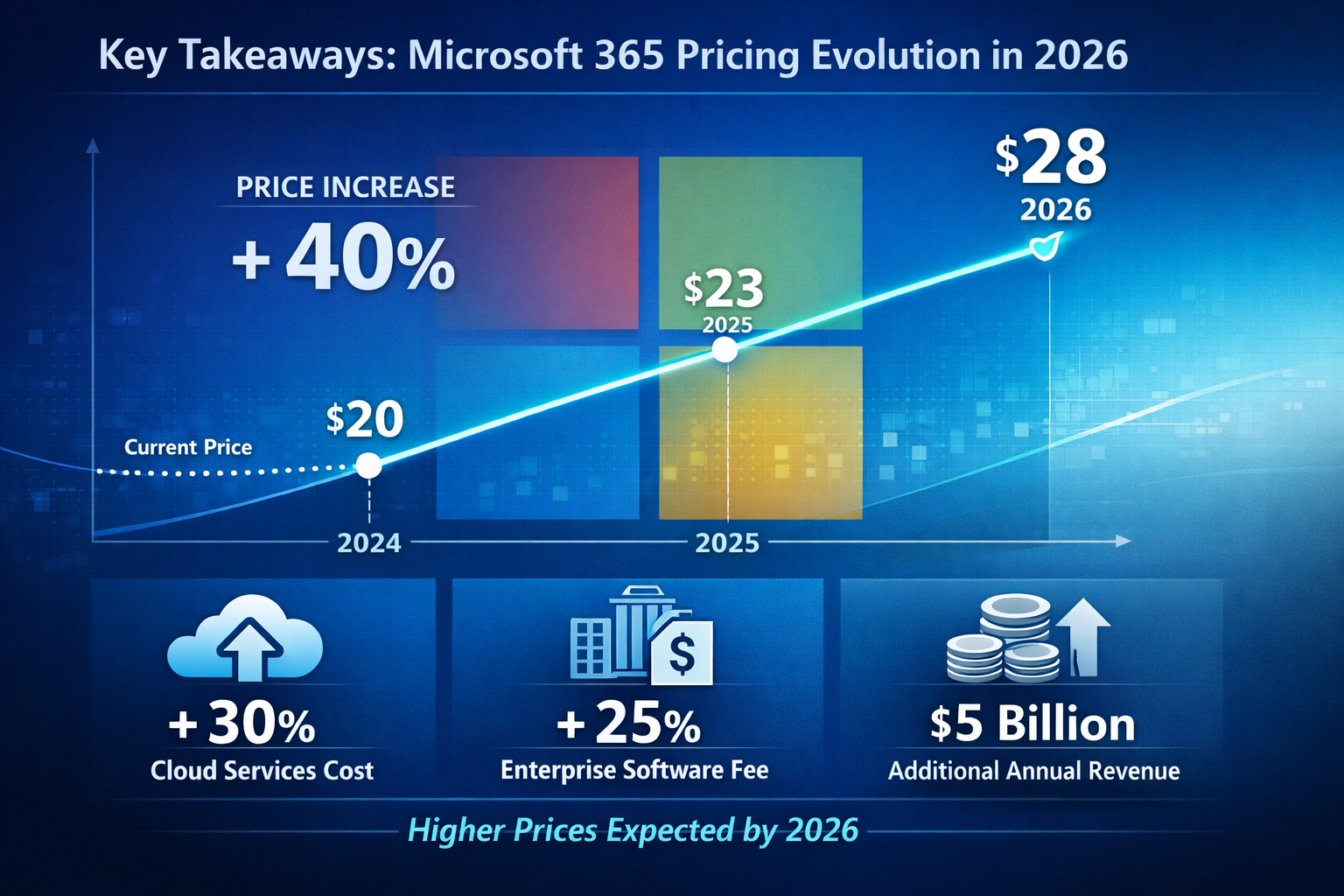
Microsoft has rolled out pricing changes across three key dates in 2026.
February 1, 2026, brought local currency adjustments for European markets. These changes affected commercial cloud services and varied by region due to currency fluctuations [5].
On February 14, 2026, the Office 365 Family subscription increased from $99.99 to $129.99 annually, a 30% increase that caught many home users by surprise [8][9].
The big one is July 1, 2026. That's when major commercial suite restructuring and price increases take effect for both new subscriptions and renewals[1][2]. This date affects businesses of all sizes across London, Berkshire, Surrey, and the rest of the UK.
Microsoft officially announced these changes on December 4, 2025, via their Microsoft 365 Blog[2][6]. The announcement gave businesses roughly seven months to prepare, which sounds like plenty of time, but renewal cycles move quickly.
What's Actually Changing with Microsoft 365 Pricing in 2026?
Let's break down the specific price changes you'll see. These apply to commercial, government, and nonprofit plans, though education pricing is still pending[1].
Business Plans
| Plan | Old Price | New Price (July 2026) | Increase |
|---|---|---|---|
| Business Basic | £6/user/month | £7/user/month | +16.7% |
| Business Standard | £12.50/user/month | £14/user/month | +12% |
| Business Premium | £22/user/month | £22/user/month | No change 🎯 |
Business Premium staying flat is significant. The gap between Standard and Premium narrows from £9.50 to £8, making Premium's security and compliance features a stronger value proposition than ever.
Enterprise Plans
Microsoft 365 E3 increases from $36 to $39 per user/month, a 8.3% increase [2].
Microsoft 365 E5 goes from $57 to $60 per user/month, a 5.3% increase[2].
These enterprise plans now include enhanced InTune Suite features and improved email protection. You're paying more, but you're also getting more built-in security capabilities that previously required separate add-ons.
Frontline Worker Plans
Here's where the increases get steep.
Microsoft 365 F3 jumps from $8 to $10 per user/month, a 25% increase[2].
Microsoft 365 F1 rises by 33%[2], the steepest increase across all plans.
If you're running a retail operation, hospitality business, or any organisation with frontline staff, these changes will have a noticeable impact on your IT budget. We see this all the time with our clients in dental practices and estate agencies across London.
Government and Nonprofit Plans
Government SKUs (including GCC and GCC High) will see an 8% price increase across the board[4]. Interestingly, Business Premium for government customers also remains unchanged, mirroring the commercial sector strategy.
Nonprofit pricing follows similar patterns, though specific increases vary by plan tier.
Why Is Microsoft Raising Prices?
Microsoft isn't just raising prices for the sake of it. The 2026 pricing changes come bundled with significant capability enhancements.
Enhanced security features are being integrated into baseline plans. Advanced email protections that once required separate licenses are now included in many Office 365 plans[6].
AI capabilities are expanding. Basic Copilot features are bundled with core applications such as Word, Excel, and PowerPoint at the base tier. If you want the full, advanced Copilot experience, that remains a separate add-on, but the baseline AI assistance is now included[3].
Storage increases are on the horizon. There's strong evidence that email storage could increase by 50GB, potentially reaching 100GB in some configurations [3]. For businesses drowning in email archives, that's a genuine value-add.
InTune Suite integration into E5 (and some elements into E3) means better device management and security without additional licensing complexity[6].
The underlying message from Microsoft is clear: you're paying more, but the platform is evolving from a productivity suite into a thorough, AI-enabled, security-focused workspace.
How Microsoft 365 Pricing in 2026 Affects Your Business
Let's talk about what this means in practical terms.
Budget Impact
If you're running a 20-person business on Business Standard, you'll go from £250/month to £280/month, an extra £360 annually. Not catastrophic, but worth planning for.
A 100-person organisation on E3 will see costs rise from roughly £3,000/month to £3,250/month. That's £3,000 extra per year.
Most problems can be fixed within an hour of reviewing your licensing footprint. Many businesses pay for licenses they don't use, shared mailboxes that don't need full licenses, former employees still on the books, or users on premium plans who only need basic features.
Strategic Opportunities
Business Premium becomes more attractive. If you're currently on Business Standard, the £8 difference now gets you advanced threat protection, device management, and enhanced compliance tools. For businesses handling sensitive data, such as law firms, dental practices, and estate agents, that's money well spent.
License consolidation makes sense. The pricing changes create an opportunity to audit your entire Microsoft 365 footprint. We've helped clients reduce their monthly spend by 20-30% just by right-sizing licenses and eliminating waste.
Security improvements are included. You're not just paying more for the same service. The enhanced protections being rolled into standard plans could eliminate the need for third-party security tools you're currently paying for separately.
Renewal Timing Matters
Your renewal window, typically January through March for many annual agreements, becomes critical. Even if you're on monthly subscriptions, reviewing your setup before July 1, 2026, gives you options.
Lock in current pricing if possible. Negotiate with your provider. Or make the strategic move to Business Premium before the changes take effect.
What You Should Do Right Now
Don't wait until June to think about this. Here's your action plan.
1. Review Your Current Licenses
Log in to your Microsoft 365 admin portal and see exactly what you're paying for. Look for:
- Unused licenses
- Shared mailboxes with full licenses (they only need free shared mailbox licenses)
- Users on premium plans who don't use premium features
- Former employees are still consuming licenses
You don't need to be technical; that's our job. But you do need to know what you're paying for. If you need help with Microsoft 365 setup or license optimisation, we come to you with no call-out fees.
2. Calculate Your New Costs
Use the pricing tables above to estimate your July 2026 costs. Multiply your user count by the new per-user price. Add any add-ons you're using.
Compare that to your current spend. If the increase is significant, you've got time to plan and potentially reallocate budget from other areas.
3. Consider Business Premium
If you're on Business Standard or Business Basic, run the numbers on Business Premium. With the narrowing price gap and enhanced security features, it may actually save you money by reducing security incidents and improving compliance.
For businesses in regulated industries, such as legal firms, medical practices, and financial services, the compliance tools alone justify the cost. We've seen this work brilliantly for our dental practice IT support clients.
4. Audit for Waste
Most organisations waste 20-30% of their license spend. Common culprits:
- Shared mailboxes with E3 licenses (should be free)
- Service accounts with full licenses (often don't need them)
- Inactive users who left months ago
- Over-licensed users on E5 who only use Outlook and Word
A proper audit takes an hour or two and can save thousands annually. We see this all the time, and most problems can be fixed within an hour.
5. Plan Your Copilot Strategy
The bundled basic Copilot features are interesting, but they're not the full experience. Decide whether your team needs:
- Just the bundled basics (included in your plan)
- Full Copilot for specific power users (add-on required)
- Enterprise-wide Copilot deployment (high additional cost)
Don't assume everyone needs the premium add-on. Target it where it delivers real productivity gains.
6. Talk to Your IT Support Partner
If you're working with a managed service provider or IT support company, schedule a licensing review now. If you're handling IT in-house, consider whether the complexity of optimising Microsoft 365 licensing justifies engaging expert help.
Our business IT support service includes licence optimisation as standard. We review your setup and show you where you may be able to reduce unnecessary licence costs, whether you're based in Slough, elsewhere in Berkshire, or across Surrey and West London. Diagnostic and support time is chargeable, with the rate agreed before work starts.
For more detailed guidance on choosing the right licenses, see our complete guide to Microsoft 365 licensing for business.
Regional Considerations for UK Businesses
While headline prices are in US dollars, UK pricing follows similar percentage increases, with local-currency adjustments [5].
Currency fluctuations between now and July could slightly affect the final pound sterling prices. Microsoft typically announces UK-specific pricing closer to the effective date.
For businesses with offices across multiple countries, regional pricing variations might create opportunities to optimise where licenses are purchased and assigned. This gets complex quickly, so professional advice is worth considering.
Government and Nonprofit Pricing
Government organisations face an 8% increase across GCC SKUs, effective July 1, 2026[4]. The parallel with commercial pricing, particularly Business Premium remaining stable, suggests Microsoft is maintaining security-focused options at accessible price points for public sector users.
Nonprofit pricing follows similar patterns, though the specific increases vary. If you're running a charity or nonprofit, factor these changes into your 2026-27 budget planning now.
What About Education Pricing?

Education pricing hasn't been announced yet[1]. Schools, colleges, and universities should watch for updates in the coming months.
Historically, Microsoft has been more conservative with education pricing increases, but don't assume you're exempt from changes.
The Copilot Question
One of the most confusing aspects of the 2026 changes is determining which Copilot features you're receiving.
Bundled basic Copilot gives you AI-assisted features in Word, Excel, PowerPoint, and other core apps. Think smart suggestions, content generation assistance, and basic automation.
The Premium Copilot add-on delivers the full experience, advanced AI capabilities, deeper integration, and more sophisticated automation. This remains a separate purchase.
The market is still figuring out the practical difference between these tiers. Microsoft's messaging has been unclear, and we're seeing confusion among businesses making purchasing decisions.
Our advice: start with the bundled features when they roll out. Test them with a small group. Only invest in Premium Copilot if you see clear productivity gains that justify the additional cost.
Long-Term Outlook
Microsoft 365 pricing changes in 2026 aren't a one-off event. They're part of a broader shift in how Microsoft positions its cloud services.
Expect continued evolution toward:
- Security-first licensing, where baseline plans include reliable protections
- AI integration across all tiers, with premium AI as an add-on
- Consumption-based pricing for some features (already happening with Power Platform)
- Regular pricing adjustments tied to capability enhancements
The days of static, predictable Microsoft licensing are behind us. Successful businesses will build flexibility into their IT budgets and review licensing at least annually.
Common Questions We Hear
"Can I avoid the price increase by renewing early?"
Maybe. Some licensing agreements allow you to lock in current pricing for the renewal term. Check with your provider or Microsoft partner. Don't assume this works. Read the fine print.
"Should I switch to Google Workspace or another alternative?"
That's a bigger decision than just pricing. Consider migration costs, retraining, integration with existing systems, and whether the alternative actually saves money over the long term. For most businesses deeply embedded in the Microsoft ecosystem, the switching costs outweigh the subscription savings.
"What if I just need email and basic Office apps?"
Then Business Basic at £7/month might be perfect. Don't overpay for features you won't use. But don't underestimate security email; it's the number one attack vector for cybercriminals.
"Will prices keep rising every year?"
Probably not annually, but expect periodic adjustments. Microsoft has historically gone 2-3 years between major pricing changes. The 2026 increases are the first significant commercial pricing update since 2022.
How Verge Tech Solutions Can Help
Our senior engineers help businesses in London, Berkshire, and Surrey with Microsoft 365 — licensing, migration, identity and support. We know the licensing landscape inside and out.
Our Microsoft Office 365 solution service includes:
✅ License audit and optimisation – We find waste and right-size your subscriptions
✅ Migration and setup – Moving to the right plan without disruption
✅ Ongoing support – Email setup, user management, troubleshooting
✅ Security configuration – Making sure you're actually protected, not just licensed
Whether you're a small business trying to understand these changes or a larger organisation needing strategic licensing advice, we're here to help. Get in touch for a no-obligation chat about your Microsoft 365 setup.
Conclusion
Microsoft 365 pricing in 2026 is changing significantly, but it's not all bad news. Yes, most plans are getting more expensive—some substantially so. But you're also getting enhanced security, AI capabilities, and more storage.
The key is planning. Review your licenses now, eliminate waste, consider whether Business Premium makes sense for your organisation, and budget for the July 1 increases.
Don't worry, this is a common issue affecting every business using Microsoft 365. You're not alone in navigating these changes.
Your next steps:
- Log in to your Microsoft 365 admin portal and count your licenses
- Calculate your new July 2026 costs using the tables in this article
- Identify unused or over-allocated licenses
- Consider whether Business Premium offers better value
- Schedule a licensing review with your IT support partner
If you need help with any of this, we're just a phone call away. We've helped hundreds of businesses across London optimise their Microsoft 365 setups, and we'd be happy to do the same for you.
For more Microsoft-related guidance, see our Microsoft 365 setup and support or learn about Microsoft Entra security to make the most of your investment.
The pricing changes are coming. But with the right preparation, you'll navigate them smoothly and might even end up with a better, more secure setup than you have today.
References
[1] Major Microsoft 365 Pricing Change 2026 - https://www.hbs.net/blog/major-microsoft-365-pricing-change-2026
[2] Microsoft 365 July 2026 Price Increase - https://samexpert.com/microsoft-365-july-2026-price-increase/
[3] Microsoft 365 Pricing Changes In 2026 What You Really Need To Know - https://tminus365.com/microsoft-365-pricing-changes-in-2026-what-you-really-need-to-know/
[4] techcommunity.Microsoft - https://techcommunity.microsoft.com/blog/publicsectorblog/advancing-microsoft-365-government-new-capabilities-and-pricing-update/4474648
[5] Microsoft 365 Pricing Changes In 2026 - https://www.bsure.io/insights/microsoft-365-pricing-changes-in-2026
[6] Advancing Microsoft 365 New Capabilities And Pricing Update - https://www.microsoft.com/en-us/microsoft-365/blog/2025/12/04/advancing-microsoft-365-new-capabilities-and-pricing-update/
[8] Early Increase In Renewal Rate For Annual Subscription - https://learn.microsoft.com/en-us/answers/questions/5705183/early-increase-in-renewal-rate-for-annual-subscrip
[9] Why Is My Microsoft 365 Price Being Increased Befo - https://learn.microsoft.com/en-us/answers/questions/5675264/why-is-my-microsoft-365-price-being-increased-befo
Microsoft 365 and business email support
Need help with Microsoft 365, Outlook or business email?
Verge Tech supports Microsoft 365, Outlook, Teams, SharePoint and custom business email for small businesses across London, Berkshire and Surrey.
Keep reading
Related IT guides
Microsoft 365 Licensing for Business: Complete 2025 Guide
Imagine discovering your organisation has been spending £66,000 annually on software licenses you don't actually need, enough to fund an entire new...
How to fix Microsoft Outlook Closes When Minimised
Home Last updated: February 25, 2026 Key Takeaways Outlook closing when minimised is a common issue. Don't worry, it's almost always fixable without...
How to Set Up External Email Forwarding in Microsoft 365
to protect against data leaks and phishing attacks You must enable external forwarding at the admin level before individual mailboxes can forward to...
Written by
Noman Maqsood (Nomi)
Senior IT Engineer · Azure Certified
Nomi has 7+ years in cloud, networking, and hybrid infrastructure. He writes about practical IT solutions — no jargon, just what actually works.
More from Nomi at nmaqsood.com →